The jury at the Santiago site chose NOVA as the winner of the NASA Space Apps Challenge 2026, in the challenge “Create Health Monitoring Software for Astronauts on Space Missions”.


Six people from Chile, one weekend, one working system: flight core, ship screens, medical station, phone app and on-board AI.
NOVA is a working prototype built for NASA Space Apps 2026. It runs on a ship computer around NASA's F Prime flight software, with every model on board. The crew and their numbers are demo data.
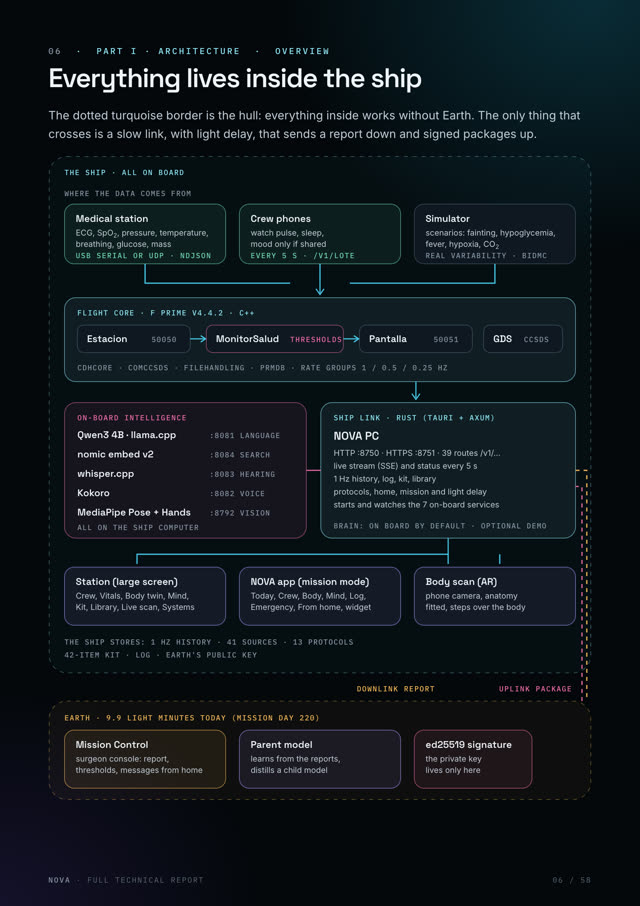
No internet and no cloud during the mission. A medical station and each astronaut's phone feed NASA's F Prime flight core, and five small models on the ship's own computer turn those numbers into care the crew can act on.
 Flight core
Every reading is checked against limits the flight surgeon can change from Earth.
F Prime · NASA JPL · CCSDS packetsAnswers, explains and writes the nightly report. It never decides a medical step.
Qwen3 4B · llama.cpp · offlineUnderstands the crew and reads every step aloud, in English and Spanish.
whisper.cpp · KokoroSees the body and the rescuer's hands through a phone camera, about 15 ms a frame.
MediaPipe Pose + Hands · ship GPU41 open sources and 35,830 passages. Every answer opens the real page it came from.
Gray's Anatomy · OpenStax · ISS medical kitToday it identifies each astronaut with an NFC card and records an ECG. It is designed to add oxygen, blood pressure, temperature, glucose, cognitive fatigue and gut microbiota.
Built by our team · Arduino · AD8232 · NFCCaptured from NOVA running on our ship computer, with the demo crew: Mara, David, Ingrid and Kenji.

CPR footage under the scan: «RCP.ogv» by Primerosauxilios, CC BY-SA 3.0, Wikimedia Commons.
Without weight on them, the hip and leg bones lose 1 to 1.5% of their density each month, and posture muscles shrink fast. NOVA's body twin projects every crew member with and without their exercise plan, so skipping a session has a visible cost.


Mara Reyes, day 219 of a demo mission. Rates from the NASA Human Research Program (bone fracture and muscle evidence reports) and NASA OCHMO-MTB-013 (2026): resistance exercise on the ARED protects bone about equally in women and men (Smith et al., JBMR 2014).
The NOVA app has a mission mode: no cloud, only the ship's local network. To the flight core a phone is one more medical station, and everything a person needs in a bad moment keeps working even if the link drops.


With the ship's address and a seat (T1 to T4), the phone stops using the cloud and talks only to the ship. It uses the same data contract as the medical station.
Expo SDK 57 · React Native 0.86 · POST /v1/lote every 5 sNova's summary of the day, the Emergency button and the signs the ship is seeing, in ship time.
GET /v1/estado every 5 sSleep, mood and energy in a few taps. The journal never leaves the phone; mood reaches the ship only if they choose "Share my day".
Privacy by designEvery crewmate live from the ship, with a one-tap "Help" when someone is not doing well.
Crew viewThe same 13 protocols as the ship live inside the app. With the link, the guide shows the person's signs, speaks with Nova's voice and logs each step; CPR comes with a haptic metronome.
src/emergencia/protocolos.json · /v1/decir · /v1/bitacoraFamily photos and messages arrive when the light delay is met, stay on the phone without the link and show up on the Android widget.
/v1/casa · Android widgetPrivate cycle care or suppression, the neck-vein ultrasound NASA now asks for, supplies counted to the end of the mission and readiness for landing.
NASA OCHMO-MTB-007, 2026 · npj Microgravity 2025A one-time QR code that renews every 30 seconds opens the station for its owner, so a photo of it stops working right away.
POST /v1/qrReal captures of the NOVA app with a demo crew. NOVA is not a medical device: care signals point to the flight surgeon and are not a diagnosis.
A report of about 6 KB leaves the F Prime core as CCSDS packets and crosses up to 22 light-minutes to Earth. Updates come back signed with ed25519, and the ship checks the signature before installing them and rolls back if anything fails. The next stage is knowledge distillation: a larger teacher model on Earth learns from each report, flight surgeons review every change, and it trains the smaller model that flies on board.
One night of the loop, running live. Move the ship farther from Earth, hide it behind the Sun, or try to slip a bad update past Mission Control.
Illustrative simulation of the proposed design. One-way light time between Earth and Mars ranges from about 3 to 22 minutes, and around solar conjunction, roughly every 26 months, Mars missions pause commanding for about two weeks (NASA). Report and update sizes, alert error and approvals are design targets and demo data.
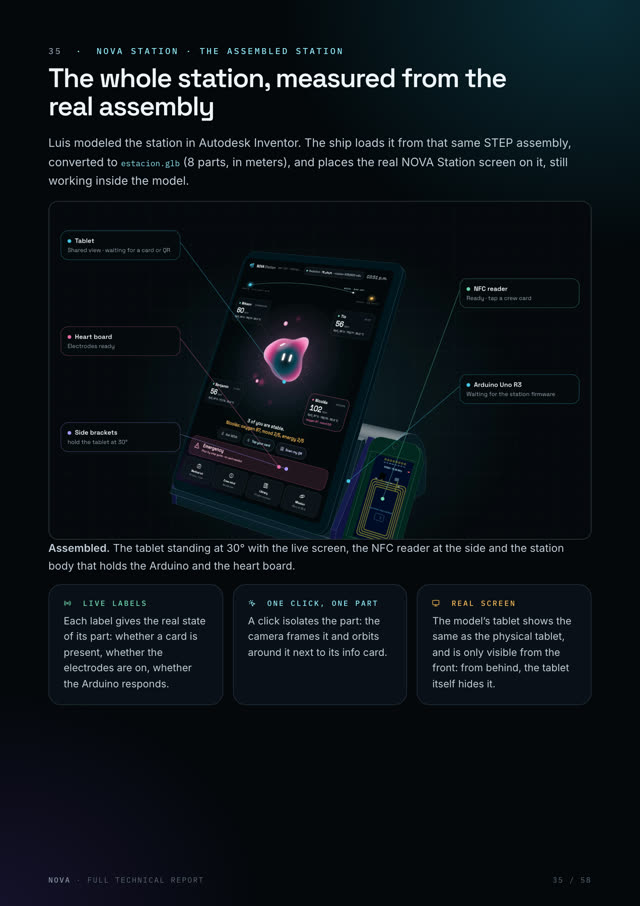
The whole of NOVA as it stands after the hackathon: the F Prime core, the ship screens, NOVA Station and its hardware, the AR body scan, the phone, the signed loop with Earth, the team's research, and every NASA document and dataset behind it.
PDF · 10 MB · updated November 15, 2026 · Spanish version

average distance from Earth to Mars
for a message to reach home, one way
of hip bone density lost in microgravity
for a round trip to Mars, over NASA's 600 mSv career limit
The flight core, the ship screens, the station, the phone app, the vision and voice models and the link with Earth, with the build notes for each part.
nave/vuelo/Flight coreF Prime · C++ · FPPnave/tripulacion/Ship screensTauri · Rustnave/estacion/Station contract and NFCArduino · AD8232station/NOVA Station tabletExpo · TypeScriptapp/Astronaut phone appReact Nativenave/vision/Body and hand trackingMediaPipe · Pythonnave/voz/Speech and voicewhisper.cpp · Kokoronave/biblioteca/41 open medical sourcesPythonnave/tierra/Nightly report, signed updatesCCSDS · ed25519web/This websiteHTML · JSYes. NOVA is a working prototype our team built for the NASA Space Apps Challenge 2026, for the challenge "Create Health Monitoring Software for Astronauts on Space Missions". The flight core, the ship screens, the station tablet, the phone app and the body scan all run today. The station measures ECG today; the other sensors are the next stage. The crew and their numbers are demo data.
No. Every model runs on the ship's computer, offline. Once a night, NOVA sends Mission Control a report of about 6 KB, and improvements come back signed, with the real delay of light.
She or he decides. Vital signs go to the flight surgeon. Mood leaves the phone only if they choose to share their day, cycle care stays on the phone unless she sends a summary, and the journal never leaves it.
It follows what NASA has learned: private cycle care or menstrual suppression, the neck-vein ultrasound NASA now requires, urgent signs for clots, supplies counted to the end of the mission, anemia and urinary checks, and readiness for landing.
No. Emergency steps come from a reviewed file with their source and page, and the limits live in the flight core. Nova explains and guides; the crew and their doctors decide.
41 open medical sources on board (35,830 passages), NASA's Human Research Program evidence, NASA-STD-3001, public heart data from PhysioNet for the simulator, and NASA bed-rest data from the Life Sciences Data Archive for the team's research.
NASA Space Apps Challenge · November 14–15, 2026